Gabriele Bertoli / Imperial College London

AI for understanding water systems.

I work on large language models (LLMs), machine learning (ML), and data assimilation (DA) for water science. My current focus is developing LLMs to extract relevant knowledge from unconventional sources to improve hydrological modelling, hazards forecasting and decision-making.
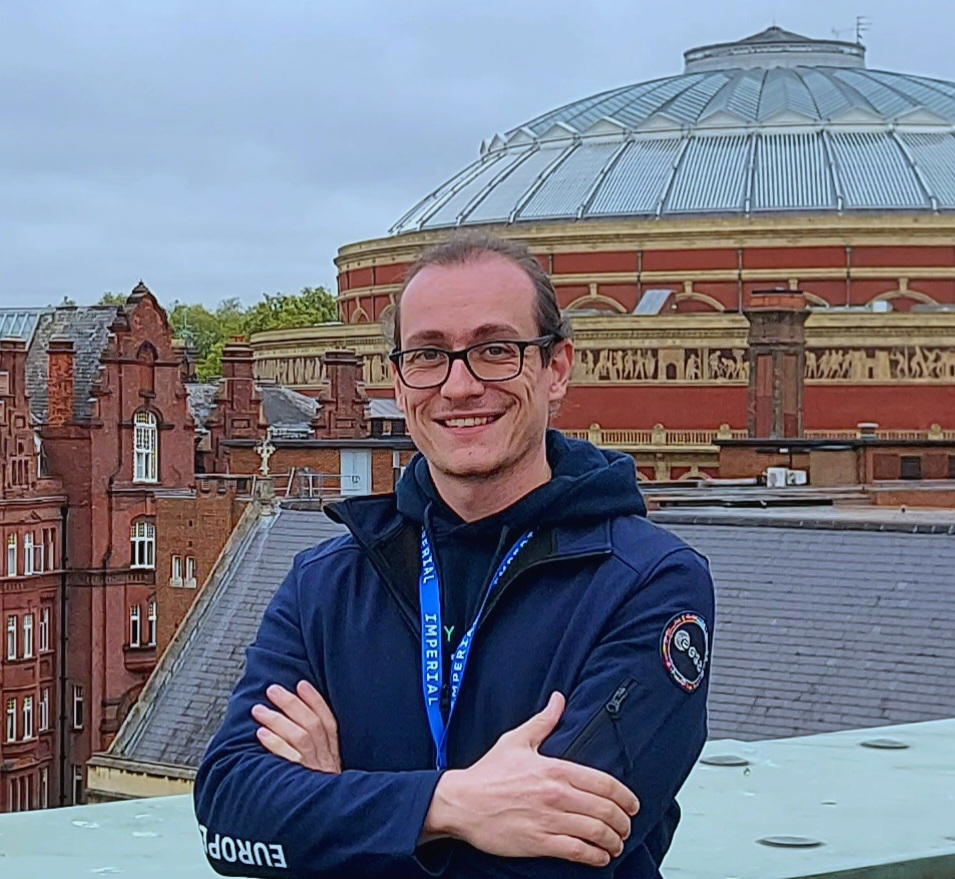
Research collaboration with ESA Φ-lab · CIN

Gabriele Bertoli
Gabriele Bertoli Postdoctoral Research Associate
Imperial College London
Postdoctoral Research Associate Imperial College London Department of Earth Science and Engineering
Research programme VIEW · Unlocking Virtual Institute for Earth’s Water · Schmidt Sciences

Research groups & collaborations

Data Learning group Rossella Arcucci Scalable Scientific Machine Learning Lab Ben Moseley
ESA Φ-lab Research collaboration · Earth observation & AI Collaborative Innovation Network (CIN)
01 / Research

LLMs, machine learning,
and data assimilation.

AI connects the strands of my research: extracting knowledge with LLMs, learning from environmental data, and combining observations with models. Water systems and flood risk are the application context.

LLMs & knowledge
extraction

Developing large language models to extract meaningful information from interviews, surveys, and local experience.

Information extraction · Unconventional knowledge sources

Machine
learning

Developing machine learning and representation-learning methods for hydrological forecasting, from hybrid tree-based models to recurrent networks and convolutional autoencoders.

ML · LSTM · XGBoost · Random Forest · Autoencoders

Data
assimilation

Combining observations with forecasting models through variational data assimilation, including latent-space methods that use learned representations and model surrogates.

DA · 3D-Var / 4D-Var · Latent-space modelling

02 / Projects & outputs

Selected work.

LLM development, machine learning, and data assimilation in practice, alongside research on flood risk and environmental exposure.

01 / Current research · LLMs

Unlocking

Unlocking Local Knowledge Production for Global Water Reanalysis · VIEW

I develop large language models to extract meaningful information from interviews, surveys, and local experience.

The wider project connects locally produced knowledge, citizen observations, and monitoring data with global water reanalysis, as part of Schmidt Sciences’ Virtual Institute for Earth’s Water (VIEW).

02 / Machine learning & data assimilation

Latent-space DA for discharge forecasting

CAE + LSTM surrogates • 3D-Var/4D-Var
  • Representation learning to reduce DA computational cost.
  • Multi-catchment evaluation (e.g., EFAS / LamaH-CE style settings).
  • Focus on accuracy gains and scalable workflows.
03 / LLMs & social sensing

LLM-based social sensing for floods

Earlier work · Information extraction & rapid mapping
  • Explored extracting flood location and extent from social media text.
  • Considered multimodal extensions using images and video for impact mapping.
  • Designed for rapid, uncertainty-aware situational awareness.
04 / Environmental exposure

EnvXflood

Environmental flood exposure framework
  • Ecosystem-services framing + participatory valuation for environmental assets.
  • Case studies and qualitative exposure attributes for environmental typologies.
05 / WebGIS & open data

CASTLE

WebGIS & Open Data · Project manager · In preparation
  • Platform requirements, metadata specification, QA/QC and delivery validation.
  • Supports reservoir mapping and water-management decision workflows.
03 / Publications

Recent publications.

The latest public works from my ORCID record. Explore the full list for earlier research.

Explore my publications

Browse papers and research outputs on ORCID or Google Scholar. Recent works appear here when the publication feed is available.

View ORCID record
04 / About

A little background.

From observations to understanding
A connected river catchment An illustrative river network, with branching tributaries, terrain contours, and observation points. This is a schematic, not a map or measured data. OBSERVE ASSIMILATE FORECAST
Connected catchments. Informed forecasts. Conceptual illustration

I am a Postdoctoral Research Associate in the Department of Earth Science and Engineering at Imperial College London. My research spans AI, large language models, machine learning, and data assimilation for water science. I currently focus on developing LLMs to extract meaningful information from unconventional knowledge sources, including interviews, surveys, and local experience.

I am a member of the Data Learning group, led by Rossella Arcucci, and the Scalable Scientific Machine Learning Lab, led by Ben Moseley.

My collaboration with ESA’s Φ-lab connects generative AI, Earth observation, and water science. This builds on a visiting research appointment involving SAR-based hydrometric measurements and SWOT-related work.

My work is part of Unlocking Local Knowledge Production for Global Water Reanalysis, a project within Schmidt Sciences’ Virtual Institute for Earth’s Water (VIEW).

Research background

My background is in civil and environmental engineering, including work with the WATERSCAPES Research Group at the University of Florence, research at TU Braunschweig, and a visiting research appointment at ESA’s Φ-lab. My earlier work includes latent-space 3D-Var and 4D-Var methods using convolutional autoencoders and LSTM surrogates for discharge forecasting across catchments such as EFAS and LamaH-CE. I also developed EnvXflood, combining ecosystem services and participatory valuation to assess environmental flood exposure, and explored social sensing for flood mapping.

05 / Experience

Research & collaborations.

Postdoctoral Research Associate

Current · Imperial College London · Department of Earth Science and Engineering
  • Developing LLMs to extract information from interviews, surveys, local experience, and other unconventional knowledge sources.
  • Member of Rossella Arcucci’s Data Learning group and Ben Moseley’s Scalable Scientific Machine Learning Lab.
  • Research within the Unlocking project, part of VIEW.

ESA Φ-lab collaboration

Visiting Researcher · Previous appointment
  • Earth observation, SAR-based hydrometric measurements.
  • Generative AI for Earth System Science; SWOT-related work.

Researcher

Previous appointment · University of Florence
WATERSCAPES Research Group
  • AI methods + ecosystem services for sustainable water-resources management.
  • Hydraulic risk mitigation and decision-support workflows.

Doctoral research

University of Florence & TU Braunschweig · Research visit at Imperial College London
  • Thesis: Flood Risk: An Interdisciplinary Approach Integrating Hydrology and Data Science .
  • ML + variational DA for discharge forecasting; EnvXflood framework.

Research Fellow

Previous appointment · University of Florence
  • Flood risk of critical facilities (health, education).
Collaborations & service

Collaborations

  • PRIN CASTLE : small agricultural reservoirs mapping/quantification.
  • PRIMA AG-WaMED : non-conventional waters and participatory governance.
  • PRIMA NEXUS-NESS : WEFE Nexus decision-support and knowledge integration.

Academic service

  • Peer review: Nature Water ; LNCS (Springer).
  • Organising: BIP “Green and Carbon-Neutral Cities” (EUniWell Arena 3), University of Florence.
06 / Teaching

Sharing knowledge.

Workshops (University of Florence)

  • HEC-RAS modelling of Nature-Based Solutions (hands-on).
  • HEC-RAS & HEC-HMS hydraulic/hydrological modelling (hands-on).
  • Materials preparation, dataset setup, live demos, in-class support.

Supervision & outreach

  • Supervised 1 M.Sc. thesis and 1 B.Sc. thesis.
  • Public engagement on geo-hydrological risks (talks/workshops).
  • Seminar lecturer: flood risk of critical facilities (Politecnico di Milano).
07 / Contact

Let’s connect.

For catching up, email is the fastest channel.

Technical skills (high level)
  • AI/Data Science: Python, ML, explainable AI, data assimilation.
  • LLMs (local inference): Ollama; Docker (containerised deployments).
  • DevOps/Compute: Linux, server management, Git/GitHub, Colab.
  • Geospatial: GIS, WebGIS. Web/Markup: HTML, website administration.